Monday, September 10, 2012

The CBS Evening News with Jesus, a Syrophoenician Woman, & Dan Rather


a sermon on Isaiah 35.4-7, James 2.1-17, & Mark 7.24-37
September 9th, 2011 | @LCMontheHILL

One of my heroes growing up was CBS Evening News anchor, Dan Rather. I grew up in rural North Carolina, far enough away from town that we didn't have access to cable television. Of the 2.5 television stations we did receive, the only one we could get with any semblance of regularity and without project funding from NASA was CBS. So, every week night at 6:30pm my family would, like clockwork, tune into the CBS Evening News with Dan Rather


Over time, after years of watching him every night, Mr. Rather become someone whom I greatly admired. I loved what he gave me. He was my connection with the mystery of all that was happening beyond the borders of the neighboring soybean fields, all that lie outside the reach of our rural county. He took all the world’s events, wrestled out the truth, and gave it to me.

I became such a fan that at some point in elementary school I acquired a series of videocassettes CBS had produced that were essentially the greatest hits of the evening news. I watched Rather on the convention room floor in Chicago. I saw Cronkite reporting on the assassination of President Kennedy and the civil rights movement. There was Murrow taking on McCarthy. Watching, rewinding, and re-watching those videos until the tape gave out, I came to see Mr. Rather as one in a long line of the ones called to the holy vocation of news anchor, called to be society’s designated arbiters of truth. 

Sunday, June 3, 2012

An Appalachian Iliad


a Holy Trinity sermon on John 3 | June 3rd, 2012 | @ Grace, Boulder

It is good to be back living in the shadow of the mountains. As my accent might reveal in an occasional feel or well, I grew up in the shadows of the southern Appalachians. As I’ve grappled with this aspect of my identity, I have developed a deep respect for southern Appalachian literature. 

Life lived and described in prose in this place is always measured against the backdrop of the mountains. They function as monuments to eternity, as sentinels of the centuries. Generations come and go, trying scape together a life in this unforgiving terrain while the mountains remain. Against this backdrop, an emphasis of human frailty emerges and with it a theology that proclaims the importance of the by and by. Humanity’s fragile fate seems as certain as the enduring presence of the mountains. Against such incredible odds, these Appalachian theologies proclaim that the best we can hope for is the life God promises in the world to come, because most assuredly the new life of Christ isn’t coming in this one. 

Monday, March 19, 2012

There is this holy place I know...


There is this holy place I know...
It’s where a thread of asphalt winds through the hills of western North Carolina, tying together an old white house on the top of a hill, an apple orchard, the family church, and its adjoined cemetery. It’s a thread that stretches back over centuries. This holy place is a place where as an eight year old I walked barefoot through the apple orchard. Meandering down the rows of trees, I made my way back to the big white house with its rusted tin roof, lost in the captivating world of my own imagination.

I felt the stiff blades of grass and the sun baked clay push back against my exposed feet, when suddenly something shifted and my imaginative world came crashing down into reality. Under foot something moved, something squirmed. My eyes shot to the ground. Pinned beneath my foot were scales, a white under belly, and frantic writhing. I don’t do snakes; not now and most certainly not as an eight year old. So, I can’t tell you for certain if I stepped on a snake or if it was a fire-breathing dragon. Rather, instinctively, I ran, making a bee line straight through the orchard. With each breath, my heart raced and my lungs stretched, until finally I collapsed onto the ground in a heap.

Sunday, February 5, 2012

The Oregon Trail: The Way of Christ


A sermon on Mark 1.29-39, preached at Rejoice Lutheran Church in Erie, Colorado. 

When I was in elementary school, I would race to get ready each morning. As soon as I woke up I’d cast off the covers, throw on some clothes, grab a quick breakfast, and be out the door and on my way in just minutes. When I arrived at school, I’d cautiously straddle the fine line between a quick shuffle and full on running, somewhere right around olympic speed walking, as I made my way down the covered sidewalks and linoleum floors of the fourth and fifth grade hall. The classroom at the end of this hall, the last room on the right, just before the principal’s office, cast a warm, yellow glow out into the hall and emitted a continual, reverberating hum that shook the whole of each student’s existence.

Tuesday, November 22, 2011

Christ the King of Social Media

Christ the King of Social Media
A Sermon on CtK Sunday, featuring Matthew, Ezekiel, & Ephesians.

Again this week the fires of protest rose up in Egypt, as citizens took to the streets to protest the transitional military government. As social media brought about new political kingdoms in the place of leaders who had ruled for over fifty years in Egypt & Tunisia, the church bears witness to a year that demonstrated the power of social media to bring significant change in the world.

Whether in the Middle East or in the United States, the really revolutionary power of social media is its ability to create new kingdoms. In the past our connections to each other were more or less dependent on some combination of physical geography or happenstance. But these technologies have united people on a mass scale on the basis of common interest, regardless of geography.

Freed from the bonds of friendship and kinship, niche communities have formed and thrived. Whether it’s an online kingdom dedicated to overthrowing a political leader or a community of dedicated Doctor Who fans, the social media revolution has allowed us to dive deep into ourselves, to develop connections with those who share all our same quirks and interests.

Friday, July 29, 2011

A Funeral Sermon for the Living


A sermon on Romans 8.26-39
Trinity Lutheran Church was founded by German settlers in the 1840’s. The imposing church structure, one red clay brick stacked upon another, sits resolutely atop a hill in the western Carolina countryside. Walking up the meandering road that leads to the church, its imposing and steely gray steeple juts into the sky, demanding your attention like a glass lightning rod on a tin roof. The ancient stained glass windows, spread along the sanctuary’s length, were long ago covered by a protective layer of glass. Since then decades of condensation have built up in the space between, leaving windows that can only be enjoyed from the inside and the impression that the church like her windows are well defended. It is bordered on one side by the cool, crayfish-filled waters of a meandering brook, on another by a few strands of limp barbed wire clinging to a litany of wayward fence posts, and on another it is bordered by a small patch of cleared hillside in which my ancestors lie.

Monday, July 11, 2011

The Big Red Dirt & the Big Green Vine

A sermon fragment on Isaiah 55.10-13


My brother and I, as children, were failed entrepreneurs with perpetual hope. One summer, on the tails of the roaring success of our roadside squash stand [2 happy customers served], we launched a new endeavor the following week.

Back in a hidden corner of our family’s pastures in North Carolina was a hole, carved eight feet deep into the red clay. It was while playing in the loose, crimson, granulated soil at the bottom of the hole that a light bulb illuminated over each of our heads. Squash did not sell, but perhaps, just maybe, red dirt would. And so, we hauled five gallon bucket after five gallon bucket of red dirt out of the hole to our roadside stand where it sold for five dollars a bucket. Sadly, this time, not even our grandmother was so kind as to buy our wares.

This hole and its red dirt spilled out on one end, into a bare spot in the middle of the pasture. It sat away from any trees or shadows and was baked each year by the summer sun. The sanguine  patch was the cause of much consternation for my father. Each year bag after bag of grass seed and fertilizer was spilled on this spot. Yet the grass never grew, and the rain continued to wash this free dirt away in an ever widening gully.

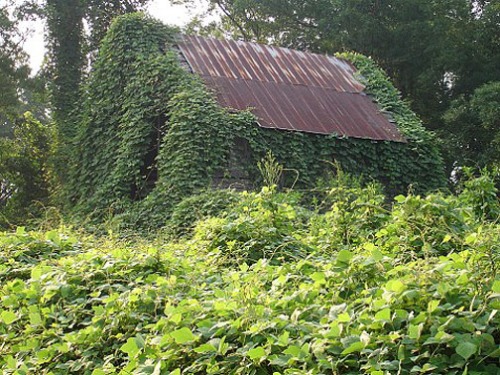
There was one option, a nuclear option of sorts, one seed which could be spilled and no doubt would cover the spot and halt the rapid withering of the soil. It is the one seed that will grow regardless of rocks, thorns, or scorched earth. Some call it mile-a-minute vine and others foot-a-nite vine. Kudzu, as it is most commonly referred to, was introduced in the south from Japan in the early 1900’s to halt erosion. And that it did, it holds the soil firmly in place, but then it keeps growing and it does not stop for anything or anyone. There seems to be no dirt, no soil, no object which the Kudzu does not find habitable. And so, it grows unchecked, reaching out and grasping the landscape, seemingly holding the whole world in the arms of its embrace. Driving through the countryside one is expected to find this vivid vine draped over telephone poles and power lines, old barns and abandoned homes. The legend goes that you have to keep your windows closed at night to keep it out, and even then there’s a reason the windows are tinted green.

Like the kudzu, the promise proclaimed this morning is the promise of the God who is beginning a new creation one small seed. One seed this creation is growing and will grow until all things, all people, the rocks, the thorns, and even the good soil will be held together in its ever widening embrace. And with that seed already been planted in the Christ, and God, bringing bread to the eater and water to the parched, is like the kudzu vine on the run. AMEN.


Click here for the full text.